

 Las Vegas, NV · Sales
Why is selling different in Las Vegas, Nevada?
Selling in Las Vegas requires navigating multi-layered corporate committees, strict regulatory standards, and high-volume stability requirements tied to peak event cycles
Selling in Las Vegas, Nevada requires sales reps to navigate strict regulatory controls and structured corporate procurement processes that protect massive, continuous operations. A standard one-on-one sales pitch rarely results in a signed contract in this market. The commercial footprint is heavily concentrated among massive enterprise buyers, public entities, and expanding regional service providers. To secure business, vendors must address regulatory compliance, high-volume stability, and operational risk before attempting to close.
Navigating Multi-Layered Management Committees in Resort Systems
Enterprise sales in Las Vegas revolve heavily around major gaming, hospitality, and entertainment systems. Companies like MGM Resorts International, Caesars Entertainment, Wynn Resorts, and Station Casinos operate under multi-layered management committees. You are almost never selling to a single decision maker. A successful account manager must build consensus across general managers, department heads, corporate procurement officers, and compliance leads.
Purchasing within these major resort systems follows rigid structured corporate procurement processes. When a vendor presents a software solution, supply item, or contracted service, the buying committee evaluates how that product interacts with existing enterprise operations. The committee's primary focus centers on efficiency, regulatory compliance, and high-volume stability. If a pitch focuses solely on feature sets without demonstrating how the service operates at scale, the deal stalls in review.
To keep pipeline momentum, account executives must map the entire committee early in the sales process. Identify the operational owner who experiences the daily friction, but immediately request engagement with the procurement and compliance teams. Providing documented workflow integration, regulatory verification, and risk-mitigation data upfront prevents the committee from tabling the deal for further internal review.
Managing High-Volume Requirements During Peak Event Cycles
The Las Vegas economy relies heavily on conventions and trade shows, alongside continuous gaming and tourism operations. Vendors supporting these operations face extreme operational demands during peak event cycles. Major resort systems and event operators cannot afford vendor failure when property occupancy is maximized or a major convention is on the floor.
Because of this operational reality, local buying committees evaluate vendor reliability under maximum load conditions. Demonstrating proven reliability during peak event cycles is a prerequisite for earning contract approval. A pitch that promises general uptime or standard service level agreements is insufficient. Buyers expect concrete proof that your infrastructure, supply chain, or staffing can handle sudden, massive spikes in demand without service degradation.
When presenting to local buyers, build your business case around peak performance scenarios. Show how your product or service performs when inventory, foot traffic, or data throughput reaches maximum capacity. Highlighting clear return on investment (ROI) tied directly to operational continuity builds long-term trust and reduces the risk perceived by committee members.
Broadening Outreach Across Healthcare, Construction, and Public Sectors
While gaming and hospitality dominate the local headlines, Las Vegas possesses significant commercial activity across healthcare, construction and real estate, and public education. Employers such as the Clark County School District and regional healthcare systems operate under their own stringent procurement rules, budget cycles, and oversight boards.
Selling to healthcare institutions and construction organizations requires the same disciplined focus on compliance and structural stability as selling to a casino operator. Healthcare buyers prioritize regulatory alignment, patient security, and strict vendor credentialing. Construction and real estate operators require firm delivery timelines, clear cost containment, and capacity to scale alongside continuous commercial development.
For the Clark County School District and public sector entities, purchasing is dictated by formal bidding protocols, board reviews, and set fiscal calendars. Sales reps must align their outreach with public budget cycles and submit comprehensive RFP responses that satisfy all regulatory requirements. Attempting to bypass these formal channels only delays contract evaluation.
Operational Discipline to Prevent Stalled Deals
Commercial purchasing in Las Vegas is designed to mitigate risk rather than adopt novel solutions quickly. When a deal stalls in this market, it is rarely because the buyer doubts the product's quality. Deals stall because the sales rep failed to address compliance hurdles, procurement requirements, or operational stress tests before the buying committee met.
To compress the sales cycle and eliminate pipeline bottlenecks, reps must change how they run discovery and validation calls. Every pitch must incorporate clear ROI calculations, documented compliance proofs, and operational contingencies. Showing a clear financial return alongside an ironclad compliance profile gives buying committees the justification they need to issue final approval.
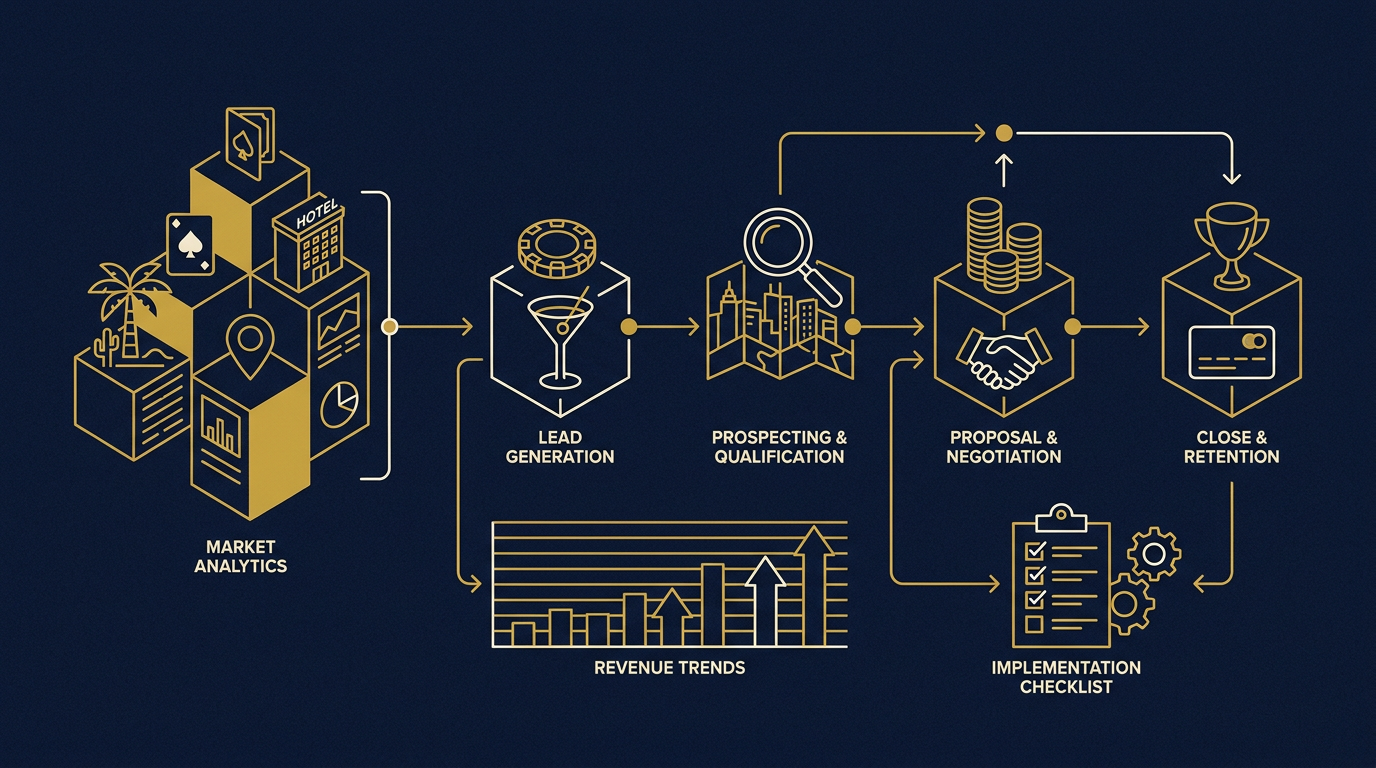
Here is a direct framework for structuring enterprise sales outreach in Las Vegas:
- Validate compliance standards and gaming regulations early in the discovery phase
- Present stress-test data demonstrating performance during peak event cycles
- Map all multi-layered management committee members across procurement, operations, finance, and leadership
- Build ROI models focused on efficiency, cost reduction, and continuous operations
- Provide referenceable service level agreements built around high-volume stability
Accelerating Las Vegas Deals and Preventing Pipeline Stalls
Selling successfully in Las Vegas comes down to reducing risk for corporate procurement teams and multi-layered management committees. When reps front-load regulatory compliance and prove high-volume stability during peak event cycles, deals pass through review boards without friction. This operational alignment directly shortens the sales cycle and prevents deals from stalling inside the buying committee, allowing local businesses to capture revenue faster.
To execute this strategy in the Las Vegas market, take these specific operational steps immediately:
First, audit your sales collateral and discovery questions to ensure they address local regulatory and procurement demands. Replace generic marketing decks with detailed operational blueprints, compliance documentation, and ROI models tailored for multi-layered committee review.
Second, re-train your sales reps to conduct thorough stakeholder mapping during the initial call. Instruct reps to identify all members of the buying committee early, including operations, finance, corporate procurement, and legal, so that all compliance and integration concerns are addressed before a formal proposal is submitted.
Third, develop dedicated stress-test case summaries that prove your service maintains high-volume stability during peak event cycles. Equip your team to present these performance metrics directly to resort, convention, healthcare, and construction buyers who demand operational continuity.