

 Houston, TX · AI
Why is AI adoption different in Houston, Texas?
AI adoption in Houston, Texas differs because local enterprise buyers in energy, healthcare, and logistics reject automated sales outreach while rewarding internal AI research that accelerates deal preparation
Enterprise Risk Limits Frontline AI Generation
Artificial intelligence adoption in Houston, Texas moves on a different axis than in consumer-facing or software-heavy markets. Commercial revenue in this region flows through capital-intensive, highly regulated sectors. Companies in energy and petrochemicals, healthcare and life sciences, aerospace and defense, international trade and logistics, and advanced manufacturing operate under rigid governance structures. In these environments, automated customer communications quickly erode vendor credibility.
Buyers at regional anchor employers like MD Anderson Cancer Center, ExxonMobil, Memorial Hermann Health System, NASA Johnson Space Center, United Airlines, and Chevron do not respond to generic automated outreach. They evaluate vendors through multi-departmental committees that include engineering, legal, safety, and procurement officers. When a sales organization uses generative software to craft outbound emails or pitch materials, the software inevitably produces generic summaries, inaccurate technical phrasing, or improper compliance language. To an enterprise buying team, receiving an automated sales pitch signals that the vendor does not understand the technical complexity of the account.
The financial and operational consequences of error in Houston enterprise sales are high. A misstated specification in a petrochemical valve supply contract or an inaccurate compliance claim in a hospital vendor submission halts deal evaluation immediately. Automated outreach engines designed for high-volume consumer SaaS outreach create unnecessary friction in commercial sales. Buyers view unverified, computer-generated outreach as an operational liability. Consequently, commercial teams that rely on frontline AI automation to replace personal sales efforts find their outreach blocked by executive gatekeepers.
Where AI Delivers Measurable Operational Value
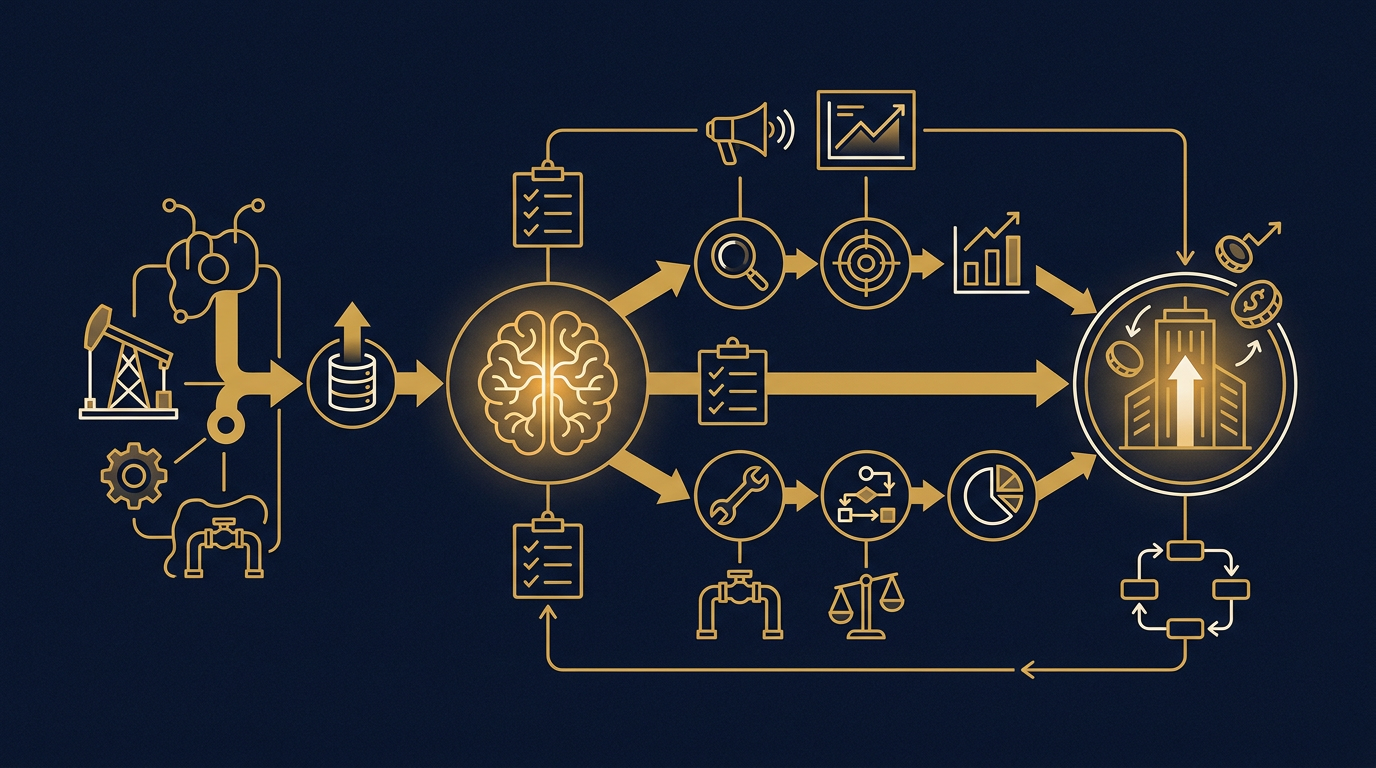
While buyer-facing AI automation damages trust, internal revenue intelligence tools provide significant competitive leverage. The value of artificial intelligence in Houston lies entirely behind the scenes, where it accelerates administrative, analytical, and research workflows without touching the prospect directly.
Houston sales representatives manage accounts with complex organizational structures and long buying cycles. Preparing for a single meeting with an enterprise buyer requires reviewing technical documentation, historical vendor contracts, safety guidelines, and infrastructure requirements. When deployed as a back-office analysis tool, AI digests dense documentation in minutes. It identifies key operational gaps, summarizes recent corporate filings, and extracts critical requirements from lengthy requests for proposals.
By shifting AI usage from outbound generation to internal synthesis, sales organizations eliminate hours of administrative overhead. Reps arrive at meetings with precise account intelligence, tailored industry context, and deep familiarity with the buyer's operational environment.
Internal AI applications that succeed in Houston include:
- Summarizing complex requests for proposals from medical systems, port logistics operators, and manufacturing facilities
- Parsing multi-page technical specification sheets to map product capabilities against safety and compliance standards
- Analyzing meeting transcripts to track buying committee objections, procurement milestones, and follow-up commitments
- Researching public filings and corporate updates from major employers to identify strategic capital projects before formal RFPs are issued
- Drafting internal account planning briefs so cross-functional team members stay aligned during multi-month sales cycles
Technical Buying Requirements in Houston Industries
The specific nature of Houston's commercial economy dictates which AI tools generate ROI and which introduce immediate operational risk. Texas maintains a business-friendly climate with no state corporate or personal income tax, though local property taxes can be high. Combined with a lower cost of doing business compared to major coastal hubs and ongoing infrastructure investments in the port and medical sectors, Houston attracts heavy enterprise expansion. However, capital efficiency requires sales teams to minimize wasted sales cycles.
In energy and petrochemicals, buying committees demand strict operational proof. AI tools that draft generic value propositions fail because they lack the domain-specific vocabulary required by plant managers and safety directors. Internal tools that index technical manuals, material safety data sheets, and engineering logs provide real utility by helping reps answer technical inquiries instantly.
In healthcare and life sciences, organizations like MD Anderson Cancer Center and Memorial Hermann Health System must comply with rigorous patient privacy laws and clinical standards. AI systems that touch patient data or send automated communications without strict governance violate regulatory protocols. Conversely, internal AI tools that map decision-making chains across clinical, financial, and administrative departments allow sales teams to navigate complex hospital systems efficiently.
In aerospace, defense, advanced manufacturing, and logistics, procurement processes revolve around supply chain resilience, safety certifications, and infrastructure capacity. Buyers managing port logistics or defense contracts evaluate vendors on technical precision. Using automated software to impersonate personal relationship management signals a fundamental misunderstanding of how enterprise contracts are awarded in Southeast Texas.
Protecting Account Relationships from Automation Friction
Commercial buyers in Houston value personal accountability, operational reliability, and domain expertise. In a market built on long-term enterprise partnerships, trust is the primary currency. Software tools that attempt to fake human intimacy, such as automated social media comments, synthetic video messages, or generic AI email cadences, fail because enterprise buyers spot them instantly.
When a sales rep sends an automated email that misstates a client's core operational priority, rebuilding that lost trust requires months of manual effort. Buyers assume that if a vendor automates their initial communication, they will also automate their service delivery, account management, and technical support.
The effective approach keeps the human seller at the center of every customer touchpoint. The sales representative authors every email, conducts every phone call, and leads every executive presentation. Artificial intelligence operates strictly as a research assistant, data analyst, and document synthesizer. This separation guarantees that every outgoing message reflects accurate technical knowledge and authentic professional respect.
Reclaiming Selling Hours for Houston Commercial Teams
For a sales leader operating in Houston, deploying AI correctly comes down to a clear operational shift: strip out administrative friction to maximize direct buyer interaction. When reps stop wasting time on manual data entry, contract analysis, and preliminary research, they reclaim dedicated selling hours per rep each week. That recovered time translates directly into more live Discovery calls, more site visits, and more thorough committee presentations across the market's industrial and medical hubs.
To implement this model effectively, execute these three concrete steps immediately:
First, audit your sales technology stack and immediately ban direct, unedited AI communications to prospective clients. Establish a strict governance policy stating that no AI-generated copy, automated sequence, or machine-written message reaches a buyer at MD Anderson Cancer Center, ExxonMobil, Memorial Hermann Health System, NASA Johnson Space Center, United Airlines, Chevron, or any regional enterprise account without complete human review and editing.
Second, configure internal AI assistants to focus exclusively on back-office sales enablement. Build prompt libraries designed to digest technical RFPs, synthesize meeting notes from procurement discussions, and outline committee structures for major healthcare and energy targets. Require reps to use AI for pre-call research rather than email generation.
Third, establish clear metrics that track how reps use their reclaimed time. Ensure that hours saved from manual meeting prep and administrative documentation are reallocated directly into high-touch activities, such as face-to-face briefings, technical reviews, and executive relationship building. By using AI to clear administrative obstacles, your team can sell more efficiently while maintaining the trust required to close complex enterprise deals.