

How to Sell More : Why Your Business Needs a Contingency Plan
You run a tight ship. Sales are up. Operations are smooth. You have a great team.
Then the unexpected happens.
A critical system crashes. Your primary supplier goes bankrupt. A key leader leaves without warning. Or a natural disaster shuts down your city.
What happens next?
If you don't have a contingency plan, the statistics are grim. According to FEMA, 90% of businesses without a contingency plan fail within one year of a major disruption.
Yet, nearly half of all businesses globally operate without any safety net. They rely on hope. But hope isn't a strategy, and it certainly won't pay the bills when your operations grind to a halt.
In our latest Sell More Academy Masterclass, we tackled this exact issue. We looked at the real cost of downtime, the types of crises you need to prepare for, and a simple framework to build a plan that actually works.
The Staggering Cost of Downtime
When things go wrong, the financial toll is immediate. The average business loses $300,000 per hour when systems go down. For larger operations, like automotive manufacturing, that number skyrockets to $2.3 million per hour.
But it's not just the direct revenue loss. You have to factor in:
Paying employees who can't work
Emergency replacement parts at premium prices
Contractual penalties for missed deadlines
Long-term reputational damage
Take Southwest Airlines in December 2022. They ignored warnings about their aging crew scheduling system. When a winter storm hit, the system collapsed. They canceled 16,700 flights, stranded 2 million passengers, and took a $1.1 billion direct financial hit.
They didn't have a plan. They paid the price.
The 4 Types of Crises You Must Plan For
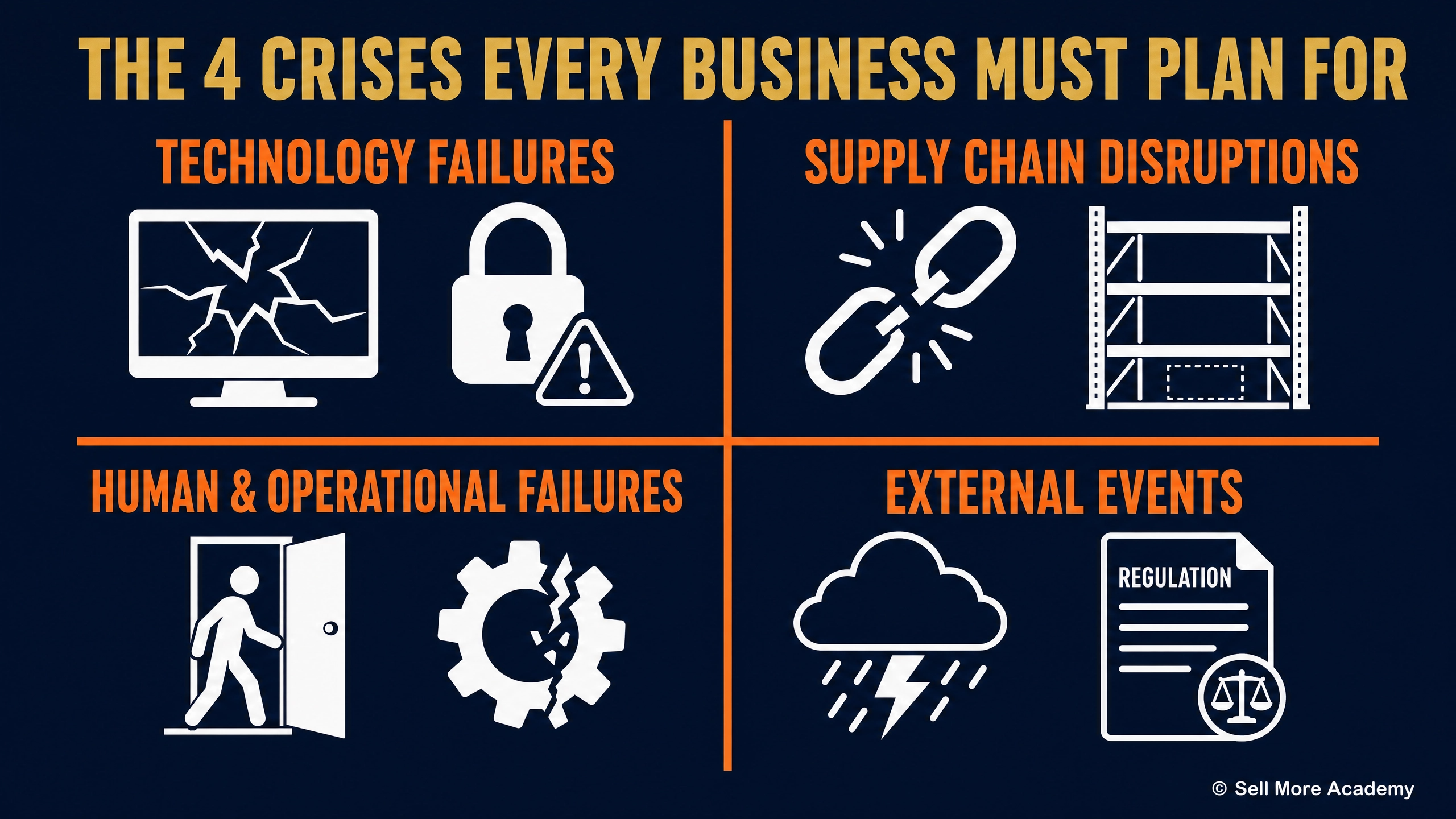
You don't need to plan for every possible scenario. You need to plan for the disruptions that will actually impact your ability to deliver. These generally fall into four categories:
Technology Failures: System outages, cyberattacks, data breaches, and power loss.
Supply Chain Disruptions: Vendor failures, ingredient shortages, and logistics breakdowns.
Human/Operational Failures: Key employee departures, process breakdowns, and human error.
External Events: Natural disasters, market shifts, and regulatory changes.
The 5-Step Contingency Framework
Building a contingency plan doesn't require a dedicated department or months of work. You can build a solid foundation in just five steps:
Identify Your Risks: Sit down with your team and ask the hard "what if" questions. What if your core system goes down for 24 hours? What if your top three people quit tomorrow?
Analyze Business Impact: Determine which functions are critical to your survival. Revenue generation and customer-facing operations get the highest priority.
Design Your Response: For each critical risk, define the trigger (when the plan activates), the specific actions to take, and exactly who is responsible.
Get Organizational Buy-In: A plan is worthless if nobody knows about it. Communicate the plan, assign roles, and make preparedness part of your company culture.
Test and Update: A plan that's never tested is just a fantasy. Run drills. Find the gaps. Update the plan as your business evolves.
Protect Your Revenue
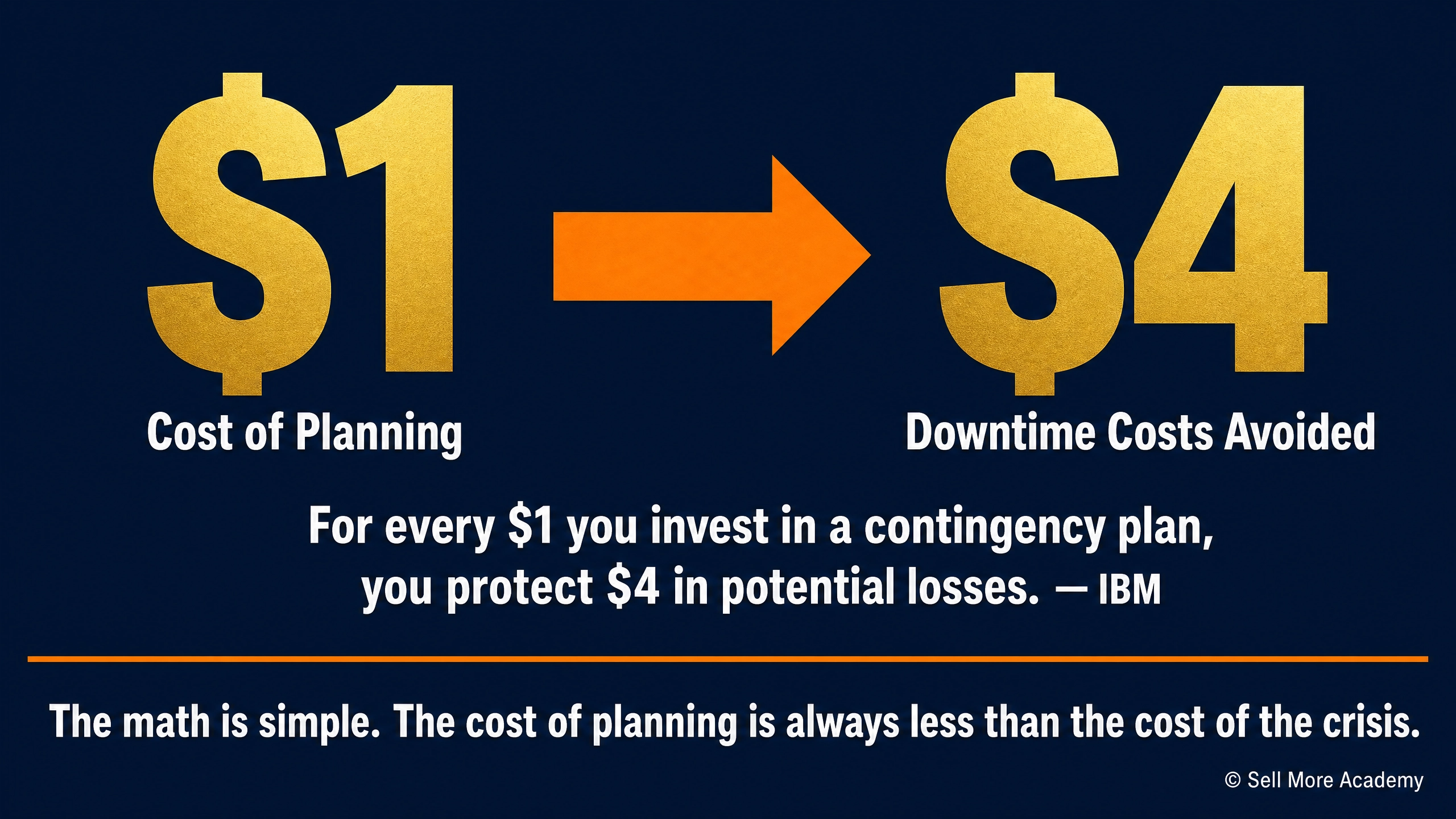
The cost of planning is always less than the cost of a crisis. For every $1 you spend on contingency planning, you avoid $4 in downtime costs.
Don't wait for the fire to start before you figure out where the exits are.
Want to dive deeper into this framework and see exactly how to implement it in your business? Watch the full Masterclass replay inside the Sell More Academy vault.
Ready to bulletproof your business and scale your sales?



Facebook
Instagram
LinkedIn
X
Youtube
TikTok
Pinterest