
How to Productize Your Services and Scale Your Business
Are you stuck in the time-for-money trap? Do you feel like every new client just means more work, more hours, and more overhead?
If you’re nodding your head, you’re not alone. Most service-based business owners hit a wall where growth feels impossible because it’s directly tied to their personal input.
But what if there was a different way? A model that detaches your revenue from your time and allows for true, exponential scale?
That model is productization, and it’s not just for tech companies. It’s a strategic pathway for any service business to break free from the hamster wheel and build a scalable asset, not just a job. In this article, we’re going to break down exactly what it means to productize your services, why it’s the key to unlocking explosive growth, and how you can start implementing it in your business today.
What is Productization?
Productization is the process of transforming your service into a standardized, repeatable, and scalable offering. Think of it as moving from custom, one-off projects to a product that could sit on a shelf. You’re essentially packaging your expertise, your processes, and your unique value into a tangible asset with a clear, non-negotiable value proposition.
When you go to the store and buy a bottle of ketchup, you don’t negotiate the price or ask for a custom formula. You know exactly what you’re getting, and you know what it costs. That’s the goal of productization. It’s about creating total clarity around your offering, eliminating the back-and-forth of custom proposals, and detaching your time from the revenue you generate.
The Power of Detachment
The real power of productization lies in detachment. When you separate the person from the product, the work can be delivered without your direct involvement in every single transaction. This is how you build a business that makes money while you sleep. You can’t offer a service 24/7 without staffing 24/7, but you can sell a product around the clock.
This detachment allows you to move from a linear growth model, where more input equals more output, to an exponential one. You build the system once, and it continues to deliver value without requiring you to start from scratch with every new client. This frees up your time, your resources, and your cognitive load to focus on higher-level strategic initiatives.
Growth vs. Scale: What’s the Difference?
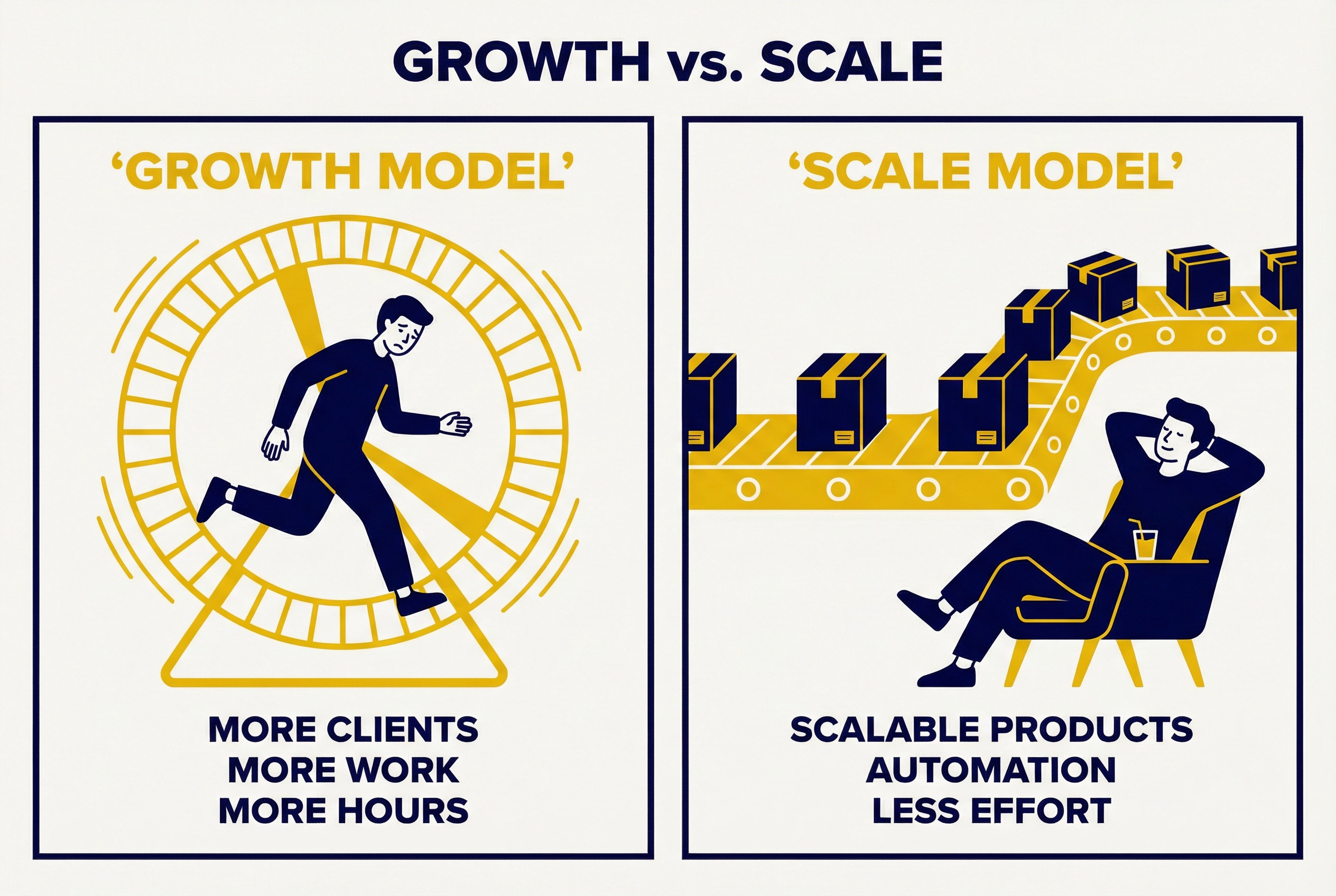
Content creators and social media gurus throw these terms around interchangeably, but they are fundamentally different. Understanding this distinction is crucial to building a truly scalable business.
Growth is simple: you add more input to get more output. You hire more people, you work more hours, you add more resources. This is where most businesses start, but it’s a trap. It’s like adding more fuel to a fire – the fire only gets as big as the amount of fuel you put in.
Scale, on the other hand, is about achieving more output with the same or less input. It’s about building systems that create efficiency and remove the bottlenecks that hold you back. It’s not about working harder; it’s about working smarter.
The growth model is fine to a point, but it will eventually lead to a ceiling. To break through that ceiling, you need to shift your focus from growth to scale. And the key to scale is productization.
How to Productize Your Services: A 3-Step Roadmap
Ready to start productizing your services? Here’s a clear, three-step roadmap to get you started.
Step 1: Identify Your Core Value
Before you can package your service, you need to understand the core value you provide. What is the repeatable process you already have that delivers a consistent result for your clients? This isn’t about reinventing the wheel; it’s about identifying the system you’re already using, even if you don’t realize it.
Ask yourself:
What is the most common problem I solve for my clients?
What are the repeatable steps I take to solve that problem?
What is the tangible outcome my clients receive?
Step 2: Define Your Package
Once you’ve identified your core value, it’s time to package it into a productized offering. This involves defining the four key components of your product:
Name: Give your product a clear, descriptive name that communicates its value.
Scope: Clearly define what’s included and, just as importantly, what’s not included. This eliminates scope creep and manages client expectations.
Price: Set a fixed, non-negotiable price for your product. This eliminates the need for custom quotes and proposals.
Delivery: Define the standardized process for delivering your product. This ensures a consistent client experience every time.
Step 3: Build Your System
With your package defined, the final step is to build the system that will deliver it. This includes creating the documentation, SOPs, templates, and automation that will allow you to deliver your product consistently and efficiently, without your direct involvement in every step.
This is where you truly detach your time from your revenue. By building a robust system, you create a scalable asset that can work for you, not the other way around.
Ready to Build Your Scalable Asset?
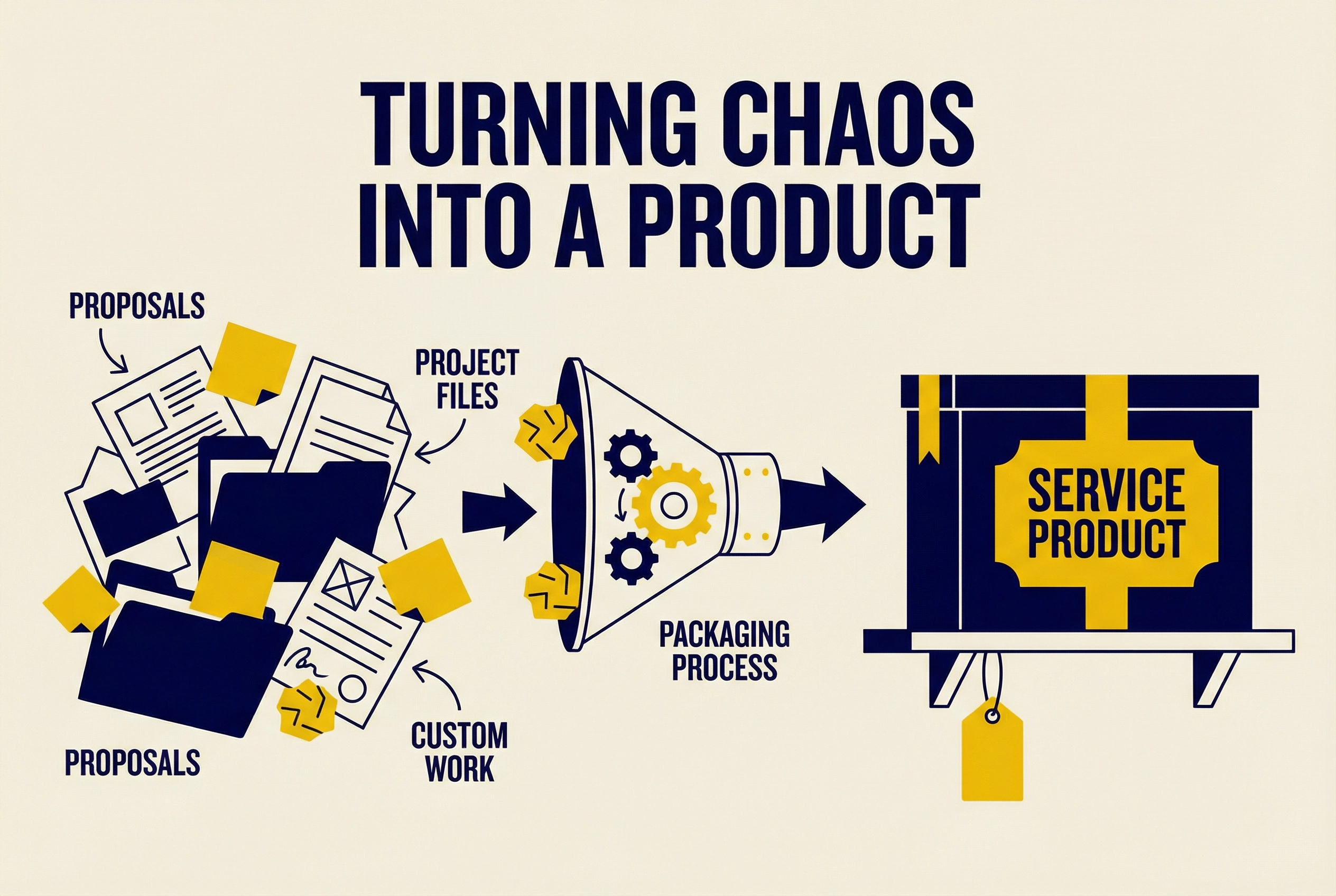
Productizing your services is the most effective way to break free from the time-for-money trap and build a business that can truly scale. It’s not about working harder; it’s about building a system that works for you.
If you’re ready to stop trading time for money and start building a scalable asset, join Sell More Academy today. Our community, resources, and masterclasses will give you everything you need to productize your services and unlock explosive growth.


Facebook
Instagram
LinkedIn
X
Youtube
TikTok
Pinterest